




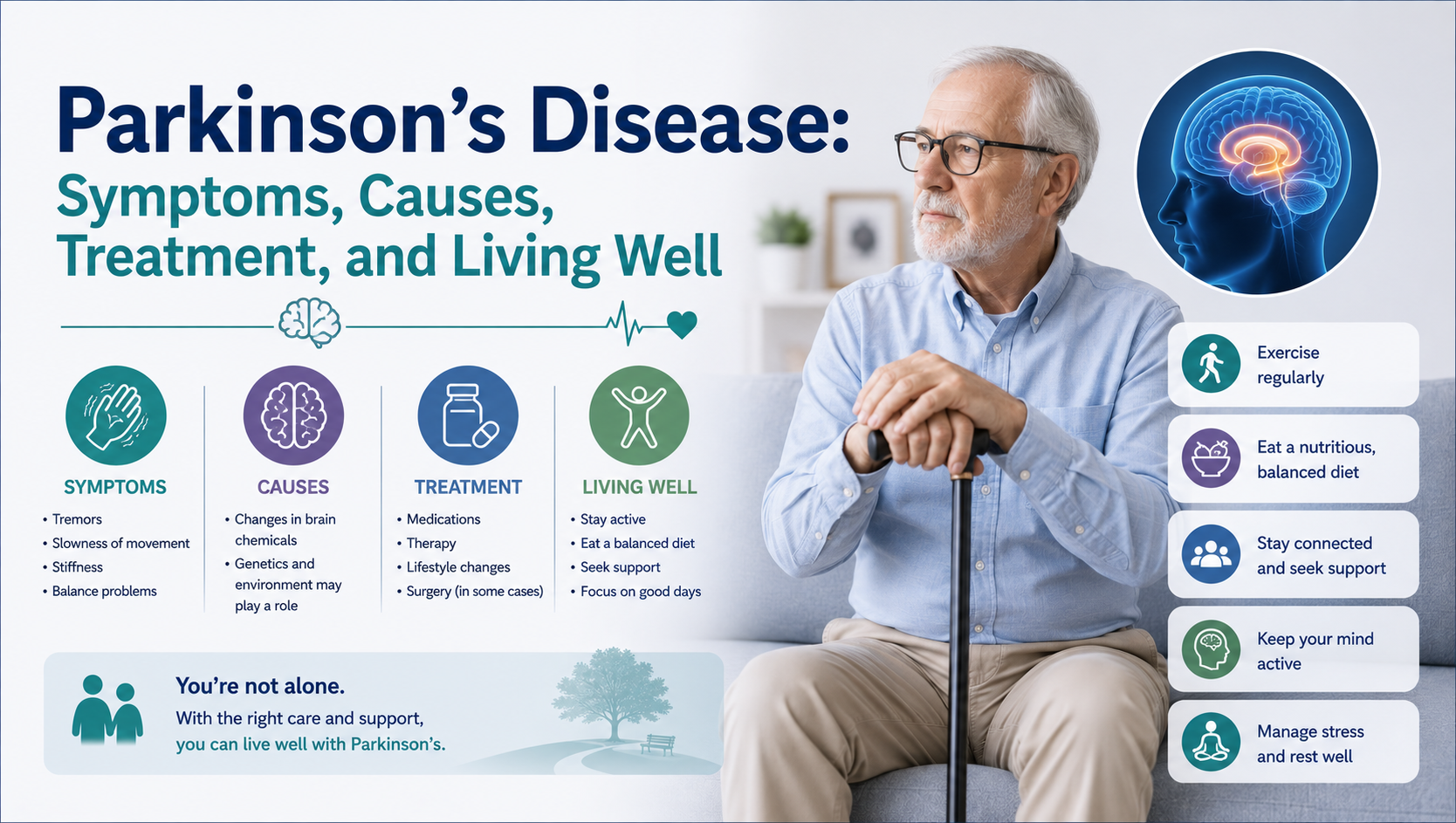
- Parkinson’s disease is a progressive neurological disorder that affects movement, caused by a loss of dopamine-producing brain cells.
- Early signs such as reduced sense of smell, constipation, voice changes, or small handwriting can appear years before motor symptoms like tremors and stiffness.
- While there’s no cure, medications, therapies, and in some cases surgery can help manage symptoms and improve quality of life.
- Lifestyle factors — including exercise, balanced diet, and mental stimulation — play an important role in maintaining independence.
Understanding Parkinson’s Disease
Parkinson’s disease is a long-term disorder of the nervous system that primarily impacts movement. It occurs when nerve cells in a part of the brain called the substantia nigra gradually deteriorate, reducing dopamine production. Dopamine is a chemical messenger that helps coordinate smooth and controlled muscle movements. When its levels drop significantly, symptoms begin to emerge.
Although the disease cannot be cured, treatments can help manage symptoms, slow progression, and improve quality of life. The condition typically develops after the age of 50, though early-onset cases do occur.
Symptoms and Early Signs
The progression of Parkinson’s is gradual. Early symptoms can be subtle and sometimes appear years before noticeable motor difficulties. These may include a diminished sense of smell, constipation, small and cramped handwriting, or changes in speech.
As the disease advances, hallmark motor symptoms become more apparent:
- Tremors, often starting in one hand or fingers, especially at rest.
- Bradykinesia, or slowed movements, making everyday tasks harder.
- Muscle rigidity, causing stiffness and discomfort.
- Postural instability, leading to balance issues and increased risk of falls.
Non-motor symptoms can also develop, such as depression, anxiety, sleep disturbances, fatigue, and cognitive changes. In later stages, individuals may experience difficulty speaking, swallowing, or walking without assistance.
Causes and Risk Factors
The exact cause of Parkinson’s remains unclear. Research suggests a combination of genetic predisposition and environmental factors may play a role. Key risk factors include:
- Age over 50 (risk increases significantly with age)
- Family history of Parkinson’s
- Male gender
- Long-term exposure to certain pesticides or toxins
- History of head injury
At a cellular level, Parkinson’s is associated with the presence of Lewy bodies — abnormal clumps of protein in the brain — and possible changes in mitochondrial function, which may contribute to nerve cell death.
Diagnosis
There’s no single test to confirm Parkinson’s disease. Diagnosis is based on a detailed medical history, physical and neurological examination, and review of symptoms. Imaging such as MRI or a dopamine transporter scan may be used to rule out other conditions and support a clinical diagnosis.
Treatment Options
While there is no cure, a combination of medical, surgical, and lifestyle approaches can help manage symptoms.
Medications are the cornerstone of treatment. The most common is levodopa, often combined with carbidopa to improve its effectiveness. Other drugs include dopamine agonists, MAO-B inhibitors, COMT inhibitors, anticholinergics, and amantadine. Over time, adjustments are often needed as medication effects may diminish.
Surgical options, such as deep brain stimulation (DBS), can help control movement symptoms in people who no longer respond well to medication.
Therapies — including physiotherapy, occupational therapy, and speech therapy — are vital for maintaining mobility, daily living skills, and communication.
Lifestyle and Self-Care
Exercise is one of the most beneficial lifestyle strategies for Parkinson’s. Activities like walking, swimming, yoga, and tai chi can improve balance, flexibility, and mood.
Nutrition plays a supportive role. Diets rich in antioxidants (berries, leafy greens, nuts), omega-3 fatty acids (fish, flaxseed), and fiber can help with brain health and digestion. Fava beans, which naturally contain levodopa, may also be beneficial.
Avoiding excessive dairy and saturated fats may reduce the risk of faster disease progression, though more research is needed.
Stages of Parkinson’s Disease
Progression varies, but the condition is commonly described in five stages:
- Stage 1 – Mild symptoms, usually on one side only.
- Stage 2 – Symptoms affect both sides; daily tasks become harder.
- Stage 3 – Balance problems emerge; independence still possible.
- Stage 4 – Severe symptoms require assistive devices; independent living becomes unsafe.
- Stage 5 – Advanced stage requiring full-time care, often with cognitive decline.
Complications
Parkinson’s can lead to complications such as difficulty swallowing, cognitive decline (Parkinson’s dementia), depression, hallucinations, falls, and reduced life expectancy due to related health issues.
Prevention and Outlook
There is no proven way to prevent Parkinson’s, but regular aerobic exercise, a diet rich in antioxidants, and moderation in caffeine intake may lower risk.
While Parkinson’s is not directly fatal, complications can be serious. With the right care and management, many people live fulfilling lives for years after diagnosis.
