






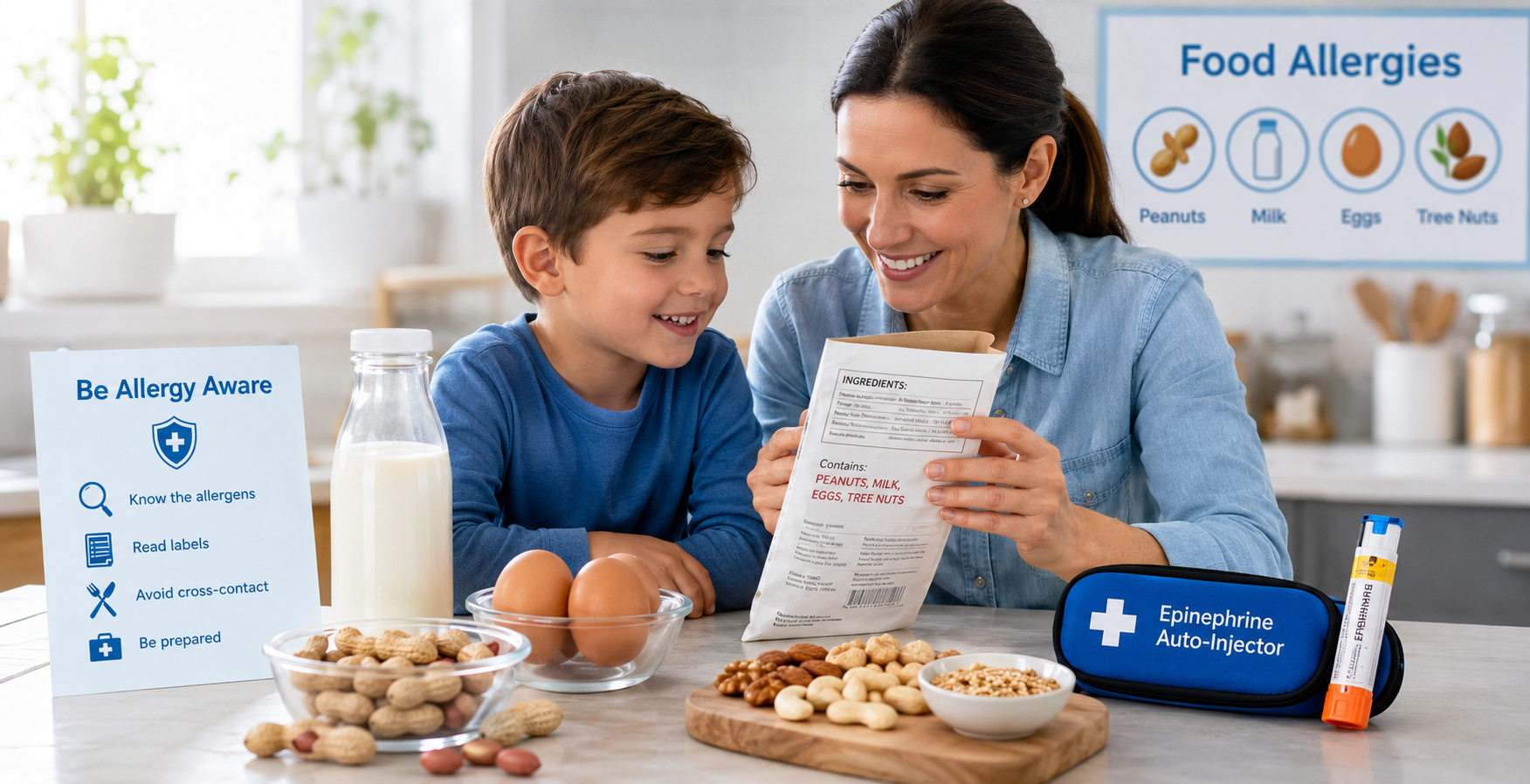
Food Allergies in Children: Signs, Diagnosis & Emergency Care
Food allergies are among the most common chronic health conditions affecting children, and their prevalence has increased steadily over the past few decades. For many families, learning that a child has a food allergy can be overwhelming. A simple meal or snack suddenly becomes something that requires careful planning, label reading, and constant awareness of potential allergens.
While many allergic reactions are mild and resolve quickly, others can develop within minutes into a life-threatening emergency known as anaphylaxis. Recognizing the early signs of an allergic reaction and knowing how to respond can make a critical difference.
Fortunately, most children with food allergies can enjoy healthy, active lives. With an accurate diagnosis, an individualized management plan, and appropriate emergency preparedness, families can significantly reduce the risk of serious reactions while helping children participate confidently in everyday activities.
This guide explains what food allergies are, why they occur, how to recognize their symptoms, and what parents should know before moving on to diagnosis, treatment, and long-term management.
What Is a Food Allergy?
A food allergy occurs when the immune system mistakenly identifies a harmless food protein as a threat. Instead of tolerating the food, the immune system produces an abnormal defensive response that releases chemicals such as histamine. These chemicals are responsible for the symptoms of an allergic reaction, which can affect the skin, digestive system, lungs, and cardiovascular system.
Food allergies are different from food intolerances. An allergy always involves the immune system and can sometimes become life-threatening, even after exposure to a very small amount of the trigger food. Food intolerance, on the other hand, is usually related to digestion and rarely causes severe reactions.
Food allergies can develop at any age, but they are most frequently diagnosed during infancy and early childhood. Some children eventually outgrow certain allergies, while others continue to have them throughout adulthood.
How Common Are Food Allergies in Children?
Food allergies are now considered one of the most common chronic conditions affecting children. Research suggests that approximately one in ten infants develops a food allergy during the first year of life, while nearly eight percent of young children are affected overall.
Children with eczema, asthma, hay fever, or a strong family history of allergic diseases have a greater chance of developing food allergies. However, allergies can also occur in children with no previous allergic conditions, making early recognition especially important.
Why Do Food Allergies Develop?
Researchers still do not fully understand why the immune system reacts to foods that are harmless for most people. Current evidence suggests that food allergies result from a combination of genetic predisposition and environmental influences during early childhood.
A child is more likely to develop a food allergy if close family members have allergic diseases such as eczema, asthma, or hay fever. Babies with moderate to severe eczema also appear to have a higher risk, particularly during the first year of life. Scientists continue to investigate how gut bacteria, environmental exposures, infections, and early feeding practices influence the development of allergic disease.
Although these factors may increase risk, no single cause explains why one child develops food allergies while another does not.
The Most Common Food Allergens
Almost any food has the potential to trigger an allergic reaction, but the vast majority of childhood food allergies are caused by a relatively small number of foods. These include cow’s milk, eggs, peanuts, tree nuts, soy, wheat, fish, shellfish, and sesame.
Among these allergens, peanuts, tree nuts, fish, shellfish, and sesame are more frequently associated with severe allergic reactions, including anaphylaxis. Nevertheless, even foods that are generally considered less dangerous can occasionally trigger serious reactions in susceptible children.
Some children react to only one food, while others may have allergies to several different foods. It is also possible to be allergic to uncommon foods such as certain fruits, vegetables, spices, or grains.
Types of Food Allergies
Not all food allergies behave in the same way. Understanding the two main categories helps explain why symptoms can vary so much between children.
The most common type is known as an IgE-mediated food allergy. In this form, the immune system produces antibodies called immunoglobulin E (IgE). When the child eats the allergenic food, these antibodies trigger the rapid release of histamine and other inflammatory chemicals. Symptoms usually begin within minutes, although they can occasionally appear up to two hours later. This is the type of allergy most commonly responsible for anaphylaxis.
The second category is non-IgE-mediated food allergy, which involves different immune pathways. Instead of causing immediate symptoms, reactions often develop several hours or even days after eating the trigger food. These children are more likely to experience persistent digestive problems, feeding difficulties, vomiting, diarrhea, or poor weight gain rather than hives or breathing problems. Conditions such as Food Protein-Induced Enterocolitis Syndrome (FPIES) and Eosinophilic Esophagitis (EoE) belong to this group and often require specialist evaluation.
Signs and Symptoms of Food Allergies
Food allergy symptoms can range from mild skin irritation to a severe reaction affecting several body systems at once. Every child is different, and the same child may experience different symptoms during separate reactions.
In many cases, symptoms begin within minutes after eating the allergenic food, although delayed reactions are possible depending on the type of allergy.
Skin symptoms are usually the earliest signs parents notice. Children commonly develop itchy hives, red blotchy rashes, swelling around the eyes, or swelling of the lips and face. Children with eczema may also experience a sudden flare after eating an allergenic food.
The digestive system is another common target. Nausea, vomiting, stomach cramps, abdominal pain, and diarrhea may occur shortly after eating the trigger food. Some children also complain that their throat feels tight or that swallowing suddenly becomes difficult.
As the reaction becomes more serious, breathing symptoms may develop. Persistent coughing, wheezing, noisy breathing, chest tightness, hoarseness, or difficulty breathing require immediate medical attention because they may indicate the beginning of anaphylaxis.
In severe reactions, the cardiovascular system can also be affected. Children may become unusually pale, dizzy, confused, weak, or faint. Infants sometimes appear floppy or unusually quiet, which may be an early warning sign of a life-threatening allergic reaction.
Food Allergy Symptoms in Babies
Recognizing food allergies in infants can be particularly challenging because babies cannot explain what they are experiencing. Instead, parents often notice changes in feeding behavior or unusual physical symptoms shortly after a new food is introduced.
An infant with a food allergy may develop facial swelling, hives, repeated vomiting, persistent diarrhea, or worsening eczema. Some babies rub their eyes repeatedly, arch their backs after feeding, push their tongue out frequently, or cry inconsolably. Others feed poorly or appear unusually floppy and less responsive than normal.
Cow’s milk allergy deserves special attention because it does not always present with an immediate allergic reaction. Instead, some infants develop chronic diarrhea, reflux, poor weight gain, or persistent eczema over time.
Because many childhood illnesses produce similar symptoms, parents should avoid trying to diagnose food allergies on their own. Any suspected allergic reaction should be assessed by a healthcare professional who can determine whether further testing is necessary.
Mild Allergic Reactions and Anaphylaxis
Not every allergic reaction is severe, but every reaction deserves careful attention because it is impossible to predict how future reactions will behave.
A mild reaction may involve only a few itchy hives, localized swelling, or temporary stomach discomfort. Although these symptoms often resolve without becoming dangerous, they should still be discussed with a healthcare professional, as future reactions may be more serious.
Anaphylaxis is the most severe form of food allergy. It develops rapidly and can affect breathing, circulation, and multiple organs simultaneously. Difficulty breathing, swelling of the tongue or throat, persistent coughing, wheezing, dizziness, collapse, or loss of consciousness are all signs of a medical emergency. Immediate treatment with epinephrine followed by emergency medical care is essential, as delaying treatment can significantly increase the risk of life-threatening complications.
How Are Food Allergies Diagnosed?
Diagnosing a food allergy is not always straightforward. Many childhood illnesses can cause symptoms that resemble an allergic reaction, and some children react only after eating foods that contain multiple ingredients. For this reason, healthcare providers do not rely on a single test. Instead, they combine the child’s medical history, physical examination, allergy testing, and, in some cases, supervised food challenges to reach an accurate diagnosis.
A correct diagnosis is essential because unnecessary food restrictions can affect a child’s nutrition, growth, and quality of life. Likewise, overlooking a true allergy could leave a child at risk of a severe reaction.
Medical History and Physical Examination
The diagnostic process usually begins with a detailed discussion about the child’s symptoms. Your doctor will ask what food was eaten, how much was consumed, how quickly symptoms developed, how long they lasted, and whether medical treatment was required. They will also want to know if similar reactions have happened before, whether your child has eczema or asthma, and if there is a family history of allergic diseases.
The timing of symptoms often provides valuable clues. Reactions that occur within minutes after eating are more likely to represent an IgE-mediated allergy, whereas symptoms that develop several hours later may suggest a different type of food allergy or another medical condition.
A physical examination may identify signs of eczema, chronic allergic disease, or other conditions that could explain the symptoms.
Skin Prick Testing
If a food allergy is suspected, your healthcare provider may recommend a skin prick test, sometimes called a scratch test. During this procedure, a tiny amount of the suspected allergen is placed on the skin, usually on the forearm or back, and the skin is gently pricked. If the immune system recognizes the allergen, a small raised bump similar to a mosquito bite usually appears within 15 to 20 minutes.
Although skin prick testing is widely used, it cannot diagnose a food allergy on its own. A positive result only shows that the immune system has developed sensitivity to the food. Some children with positive tests can eat that food without any symptoms, while others with negative tests may still have an allergy. Test results must always be interpreted alongside the child’s medical history.
Blood Tests
Blood tests can also help investigate suspected food allergies by measuring allergen-specific Immunoglobulin E (IgE) antibodies circulating in the bloodstream. Like skin testing, these results help estimate the likelihood of an allergy but cannot confirm whether symptoms will occur after eating the food.
Because both skin tests and blood tests have limitations, doctors avoid diagnosing food allergies based on laboratory results alone. Instead, they use them as one piece of the overall clinical picture.
Oral Food Challenge
When the diagnosis remains uncertain, an allergist may recommend an oral food challenge, which is considered the most reliable way to confirm or rule out many food allergies.
During this procedure, the child eats gradually increasing amounts of the suspected food under close medical supervision. The healthcare team carefully monitors for signs of an allergic reaction and can provide immediate treatment if necessary.
Although the idea may sound intimidating to parents, food challenges are performed in controlled medical settings with emergency medications readily available. They help prevent unnecessary dietary restrictions and can also determine whether a child has outgrown a previously diagnosed allergy.
Because of the risk of severe reactions, food challenges should never be attempted at home.
Food Allergy vs. Food Intolerance
Many people use the terms food allergy and food intolerance interchangeably, but they describe two very different conditions.
A food allergy involves the immune system. Even a very small amount of the offending food can trigger symptoms ranging from mild hives to life-threatening anaphylaxis. Because the immune system is involved, allergic reactions can affect multiple organs, including the skin, lungs, digestive tract, and cardiovascular system.
Food intolerance does not involve the immune system. Instead, it usually occurs because the digestive system has difficulty processing certain foods or ingredients. Lactose intolerance is a common example. Children with lactose intolerance may develop bloating, stomach pain, gas, or diarrhea after consuming dairy products, but they are not at risk of anaphylaxis.
Similarly, some children are sensitive to food additives, preservatives, or artificial colorings. While these substances may cause unpleasant symptoms, they do not produce the immune response seen in true food allergies.
Because the symptoms can overlap, it is important not to diagnose food allergies based solely on symptoms. A healthcare professional can determine whether allergy testing or additional evaluation is appropriate.
Emergency Treatment for Food Allergies
The treatment of a food allergy depends on the severity of the reaction. Mild reactions may affect only one part of the body, whereas severe reactions can progress rapidly and become life-threatening.
Every parent or caregiver of a child with a confirmed food allergy should understand the signs of anaphylaxis and know exactly how to respond if one occurs.
Recognizing Anaphylaxis
Anaphylaxis is the most serious form of an allergic reaction. It usually develops within minutes after exposure to an allergenic food, although delayed reactions can occasionally occur.
Symptoms often involve more than one body system at the same time. A child may suddenly develop widespread hives together with difficulty breathing, throat swelling, persistent coughing, wheezing, dizziness, or fainting. Young children may become unusually pale, floppy, or difficult to wake.
Because anaphylaxis can worsen within minutes, treatment should never be delayed while waiting to see whether symptoms improve.
Epinephrine Is the First-Line Treatment
Epinephrine, also known as adrenaline, is the most effective treatment for anaphylaxis. It works by rapidly opening the airways, improving blood pressure, reducing swelling, and slowing the progression of the allergic reaction.
Children who have experienced anaphylaxis or who are considered at high risk are usually prescribed an epinephrine auto-injector. Many specialists recommend that these children always have two doses available, as some reactions require a second injection before emergency medical help arrives.
One of the most common mistakes is delaying epinephrine because symptoms initially appear mild. Early administration is associated with better outcomes and can significantly reduce the risk of severe complications.
After Giving Epinephrine
Giving epinephrine is only the first step in managing anaphylaxis.
Emergency medical services should be contacted immediately after the injection because symptoms can return even after the child initially appears to improve. Healthcare professionals will continue monitoring the child and provide additional treatment if needed.
Parents should also inform schools, childcare providers, sports coaches, relatives, and other caregivers about the child’s allergy and ensure they know where the epinephrine auto-injector is kept and how to use it.
Can Antihistamines Replace Epinephrine?
No.
Antihistamines can help relieve itching or hives, but they do not treat airway swelling, breathing difficulties, or dangerously low blood pressure. For this reason, antihistamines should never be used as a substitute for epinephrine during anaphylaxis.
If severe symptoms are present, epinephrine should always be administered first. Antihistamines may be used later if recommended by a healthcare professional, but they should never delay emergency treatment.
Long-Term Treatment Options
At present, there is no permanent cure for food allergies. The cornerstone of treatment remains strict avoidance of confirmed allergens together with preparation for accidental exposure.
However, treatment options have expanded considerably in recent years, offering new possibilities for some children.
One approach is oral immunotherapy (OIT), which gradually exposes the immune system to very small amounts of the allergenic food under specialist supervision. Over time, the dose is slowly increased to reduce the likelihood of a severe reaction following accidental exposure. Oral immunotherapy does not cure the allergy, and children must continue avoiding the food unless instructed otherwise by their allergist.
Another newer option is omalizumab, a monoclonal antibody that can reduce the severity of allergic reactions in certain children with multiple food allergies. Even while receiving this medication, children must continue avoiding their trigger foods because the treatment lowers risk but does not eliminate the allergy completely.
Researchers are also investigating additional therapies that may further improve food allergy management in the future, although many remain in clinical trials.
Preventing Food Allergies
For many years, parents were advised to delay introducing highly allergenic foods such as peanuts and eggs during infancy. Research over the last decade has changed that recommendation. Current evidence suggests that introducing common allergenic foods around 6 months of age, once a baby is developmentally ready for solid foods, may actually lower the risk of developing food allergies.
Introducing foods one at a time allows parents to identify any reactions more easily. Common allergens such as peanuts, cooked eggs, dairy products, sesame, wheat, soy, fish, and tree nuts (in age-appropriate forms that do not pose a choking hazard) should generally not be delayed without a medical reason.
Babies with severe eczema, an existing food allergy, or a strong family history of allergies may require individual advice before introducing certain foods. In these situations, parents should discuss an introduction plan with their pediatrician or an allergy specialist.
Although early introduction can reduce the risk of developing some food allergies, it does not guarantee that allergies will be prevented. Researchers continue to study why some children develop allergies despite following current recommendations.
Can Children Outgrow Food Allergies?
Many children eventually outgrow certain food allergies, although the likelihood depends on the specific allergen.
Allergies to cow’s milk, eggs, wheat, and soy commonly resolve during childhood, with many children developing tolerance by around five years of age. Regular follow-up with an allergist helps determine whether an allergy is improving over time.
In contrast, allergies to peanuts, tree nuts, fish, shellfish, and sesame are generally more persistent and often continue into adulthood. Even so, some children do outgrow these allergies, which is why specialists may periodically repeat testing or recommend supervised oral food challenges when appropriate.
Parents should never reintroduce an allergenic food at home without medical guidance. A food that caused only mild symptoms years earlier may still trigger a severe reaction if reintroduced without proper evaluation.
Living Safely with a Food Allergy
A food allergy diagnosis affects much more than meal planning. It influences school, childcare, birthday parties, holidays, travel, and family gatherings. Fortunately, thoughtful preparation can dramatically reduce the risk of accidental exposure while allowing children to participate fully in everyday life.
The most effective strategy is complete avoidance of confirmed allergens. While this sounds straightforward, hidden ingredients and cross-contact can occur in many settings, making education and communication essential.
Reading Food Labels Carefully
Packaged food labels should be checked every time a product is purchased, even if it has been used safely before. Manufacturers occasionally change ingredients or production methods without obvious changes to the packaging.
Parents should become familiar with alternative names for allergens and understand precautionary statements such as “may contain” or “produced in a facility that also processes…” Although these statements do not necessarily mean the food contains the allergen, they indicate a potential risk that should be discussed with the child’s allergist.
When travelling internationally, remember that food labeling laws vary between countries. Ingredients that must be clearly identified in one country may be labeled differently elsewhere.
Preventing Cross-Contact at Home
Cross-contact occurs when a safe food accidentally comes into contact with an allergenic food. Unlike cross-contamination involving bacteria, even tiny amounts of an allergen can trigger an allergic reaction.
Simple household habits can help reduce this risk. Using separate utensils when necessary, thoroughly washing cutting boards and cookware, cleaning food preparation surfaces, and storing allergenic foods separately all decrease the chance of accidental exposure.
Every family member should understand which foods are unsafe for the child and avoid sharing utensils, drinks, or partially eaten foods.
Eating at Restaurants
Dining out requires additional planning because ingredients are not always obvious, and cross-contact can occur during food preparation.
Parents should inform restaurant staff about the child’s allergy before ordering and ask specific questions about ingredients, cooking methods, and shared preparation surfaces. If staff members are uncertain about the ingredients or cannot confidently answer questions, choosing another meal—or another restaurant altogether—is often the safest option.
Buffets and self-service food stations deserve particular caution because serving utensils are frequently shared between dishes, increasing the risk of accidental allergen exposure.
Some families find it helpful to carry a printed allergy card explaining the child’s allergy, especially when travelling or dining where language barriers may exist.
Food Allergies at School and Childcare
School is one of the environments where accidental exposure is most likely to occur because children eat, play, and share activities together throughout the day.
Parents should meet with teachers, school nurses, childcare providers, and other staff before the school year begins. Everyone responsible for the child’s care should understand which foods must be avoided, how to recognize allergic reactions, and how to administer an epinephrine auto-injector if needed.
Children with severe food allergies should have an individualized allergy or anaphylaxis action plan readily available at school. Emergency medications should be stored in an accessible location, and staff should know exactly where they are kept.
As children grow older, teaching them to recognize unsafe foods, avoid sharing snacks, and tell an adult immediately if they feel unwell becomes an important part of allergy management.
Preparing for Travel
Travelling with a food-allergic child requires additional preparation, but it should not prevent families from enjoying vacations or visiting relatives.
Parents should pack enough safe snacks for the journey, carry medications in hand luggage rather than checked baggage, and bring at least two epinephrine auto-injectors if prescribed. It is also wise to research nearby medical facilities before travelling, particularly when visiting unfamiliar destinations.
If flying, notifying the airline about the child’s allergy before departure may allow additional accommodations, although policies differ between airlines.
Creating an Allergy Emergency Action Plan
Every child with a diagnosed food allergy should have a written emergency action plan prepared with their healthcare provider. This document explains how to recognize early symptoms, when to administer epinephrine, when to call emergency services, and what additional care may be required.
Parents should share the plan with grandparents, babysitters, teachers, coaches, childcare providers, and anyone else responsible for the child’s care.
Practicing the emergency plan regularly can help caregivers respond more confidently if a reaction occurs.
Outlook for Children with Food Allergies
Although food allergies require lifelong awareness for some children, most families become increasingly confident as they gain experience managing the condition.
Regular follow-up with an allergist allows healthcare providers to monitor changes in the allergy, assess whether new treatments are appropriate, and determine if repeat testing or supervised food challenges should be considered.
Ongoing research continues to improve understanding of food allergies, and newer treatments such as oral immunotherapy and biologic medications offer promising options for selected children. While these treatments do not cure food allergies, they may reduce the risk of severe reactions from accidental exposure and improve quality of life for many families.
With appropriate medical care, careful planning, and continued education, children with food allergies can safely participate in school, sports, travel, and social activities while leading healthy, active lives.
Frequently Asked Questions
Can a child suddenly develop a food allergy?
Yes. Although many food allergies begin during infancy or early childhood, they can develop at any age, even after a child has previously eaten the food without problems.
What is the most common food allergy in children?
Cow’s milk, eggs, and peanuts are among the most common childhood food allergies, while peanuts and tree nuts are more often associated with severe reactions.
How quickly do food allergy symptoms appear?
IgE-mediated reactions usually develop within minutes to two hours after eating the allergenic food. Non-IgE-mediated allergies often appear several hours or even days later.
Can a small amount of food trigger an allergic reaction?
Yes. In highly sensitive children, even tiny amounts of an allergenic food may cause symptoms, including anaphylaxis.
What is the difference between a food allergy and a food intolerance?
Food allergies involve the immune system and can be life-threatening. Food intolerances mainly affect digestion and rarely cause severe reactions.
Should antihistamines always be used first?
No. If a child has signs of anaphylaxis, epinephrine should be given immediately. Antihistamines cannot treat severe allergic reactions.
Can children outgrow peanut allergies?
Some do, but peanut allergies are less likely to resolve than milk or egg allergies. An allergist can monitor whether the allergy is improving over time.
Is there a cure for food allergies?
There is currently no cure. However, treatments such as oral immunotherapy and biologic medications may reduce the severity of reactions in selected patients.
Can food allergies be prevented?
Current evidence suggests that introducing common allergenic foods around six months of age, when developmentally appropriate, may lower the risk of developing some food allergies.
Should children with food allergies avoid all allergens forever?
Not necessarily. Some allergies disappear with age. Your allergist may recommend repeat testing or a medically supervised food challenge to determine whether the allergy has resolved.
Key Takeaways
Food allergies occur when the immune system mistakenly reacts to harmless food proteins. While many reactions are mild, some can progress rapidly to anaphylaxis, making early recognition and prompt treatment essential. Accurate diagnosis, strict avoidance of confirmed allergens, and carrying emergency medication when prescribed remain the foundations of safe allergy management.
Although there is currently no cure, advances in allergy research continue to improve treatment options, and many children eventually outgrow certain food allergies. With education, preparation, and regular medical follow-up, families can successfully manage food allergies while helping children enjoy safe, healthy, and active lives.


