




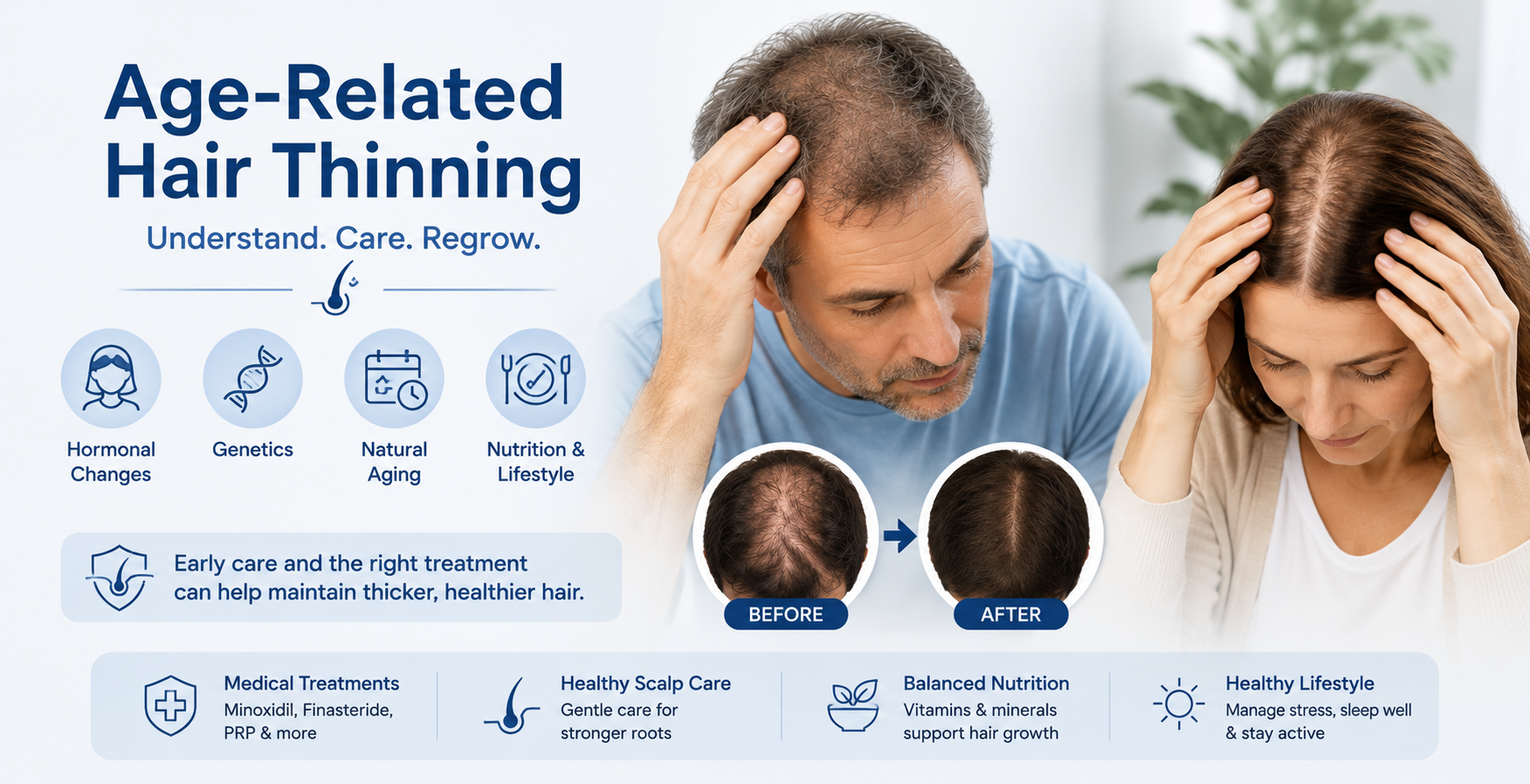
Hair naturally changes throughout life. Just as skin gradually loses elasticity and wrinkles become more noticeable with age, hair also undergoes predictable changes that affect its thickness, texture, color, and growth rate. Many people notice that their ponytail feels smaller, their scalp becomes more visible, or their hair simply does not grow as thick or as long as it once did. While these changes are often a normal part of aging, they can also be influenced by genetics, hormones, nutrition, medications, and certain medical conditions.
Age-related hair thinning affects both men and women, although the pattern and underlying causes may differ. Understanding why hair becomes thinner over time can help individuals distinguish between normal aging and conditions that require medical evaluation. Fortunately, several evidence-based treatments and healthy lifestyle habits may help slow progression and improve hair density in appropriate cases.
How Hair Changes With Age
Hair grows in a repeating cycle consisting of a growth phase (anagen), a transitional phase (catagen), and a resting phase (telogen). In younger adults, most hair follicles remain in the active growth phase for several years, allowing hair to become long and thick.
As people age, these cycles gradually change. The growth phase becomes shorter, while the resting phase may become longer. Individual hair strands often become finer, and some follicles shrink, producing thinner hairs with each new cycle.
The total number of active hair follicles may also decline over time, contributing to an overall reduction in hair volume.
Why Does Hair Become Thinner With Age?
Several biological processes contribute to age-related hair thinning.
One of the most important factors is the gradual miniaturization of hair follicles. Over time, some follicles produce progressively smaller hairs until they eventually stop producing visible hair altogether.
Hormonal changes also play a significant role. In men, sensitivity to dihydrotestosterone (DHT) contributes to androgenetic alopecia, commonly known as male pattern hair loss. In women, declining estrogen levels during menopause may reduce the protective effects these hormones have on hair growth, leading to more diffuse thinning across the scalp.
Reduced collagen production, slower cell turnover, decreased blood supply to hair follicles, and cumulative environmental damage may further contribute to age-related changes.
Normal Aging or Hair Loss?
Not all thinning hair is simply a result of getting older.
Gradual, slow thinning over many years is often part of the normal aging process. However, sudden or rapidly progressive hair loss may indicate an underlying medical condition.
Nutritional deficiencies, thyroid disorders, iron deficiency, autoimmune diseases, severe stress, certain medications, scalp infections, and hormonal disorders can all cause excessive shedding.
If hair loss develops quickly, occurs in patches, or is accompanied by scalp pain, redness, or scaling, medical evaluation is recommended.
Male and Female Patterns Differ
Age-related hair thinning often appears differently in men and women.
Men typically experience a receding hairline followed by thinning at the crown, eventually leading to larger areas of baldness in genetically susceptible individuals.
Women usually maintain their frontal hairline but notice widening of the central part and diffuse thinning across the top of the scalp. Complete baldness is uncommon in women, although significant reductions in hair volume may occur.
Understanding these different patterns helps healthcare professionals identify the most likely cause of hair loss.
Other Factors That Accelerate Hair Thinning
Although aging itself influences hair growth, several lifestyle and health factors may accelerate the process.
Smoking has been associated with reduced blood flow to hair follicles and increased oxidative stress.
Chronic psychological stress may contribute to excessive shedding by disrupting the normal hair growth cycle.
Poor nutrition, especially inadequate protein intake or deficiencies in iron, zinc, vitamin D, vitamin B12, or other essential nutrients, may also affect hair health.
Frequent heat styling, chemical treatments, tight hairstyles, and repeated bleaching can weaken hair shafts, increasing breakage and making thinning appear more pronounced.
Can Age-Related Hair Thinning Be Prevented?
Completely preventing age-related hair changes is not currently possible, but healthy habits may help slow progression.
A balanced diet rich in lean protein, fruits, vegetables, whole grains, healthy fats, and essential vitamins supports normal hair growth.
Regular physical activity improves circulation and overall health, while adequate sleep and effective stress management contribute to healthy hormone regulation.
Protecting hair from excessive heat, ultraviolet exposure, and harsh chemical treatments may also reduce damage over time.
Early treatment often produces better outcomes than waiting until substantial hair loss has occurred.
Treatment Options
Several treatments have demonstrated benefits for age-related hair thinning.
Topical minoxidil remains one of the most extensively studied over-the-counter treatments for both men and women with androgenetic alopecia. It helps prolong the growth phase of hair follicles and may increase hair density when used consistently over several months.
Prescription medications such as finasteride may be appropriate for some men under medical supervision.
Low-level laser therapy devices have shown modest benefits in selected individuals, although results vary.
Platelet-rich plasma (PRP) therapy and hair transplantation may be considered for appropriate candidates after specialist evaluation.
Cosmetic options such as volumizing hairstyles, hair fibers, and scalp camouflage products can also improve appearance while medical treatments take effect.
Hair Supplements: Do They Work?
Many supplements claim to reverse hair thinning, but evidence varies considerably.
Individuals with confirmed nutritional deficiencies often benefit from correcting those deficiencies under medical guidance.
However, taking large amounts of vitamins or minerals without deficiency has not consistently been shown to improve hair growth.
Some supplements may even be harmful in excessive doses.
Before starting supplements, it is advisable to discuss testing with a healthcare professional if deficiency is suspected.
When Should You See a Doctor?
Although gradual thinning is common with aging, medical assessment is important when hair loss develops suddenly, progresses rapidly, or is associated with additional symptoms.
Healthcare providers may recommend blood tests to evaluate thyroid function, iron stores, vitamin levels, hormone balance, or other potential contributors.
Early diagnosis allows treatment of reversible causes before permanent follicle damage occurs.
Frequently Asked Questions
Is hair thinning a normal part of aging?
Yes. Many people experience gradual thinning as hair follicles become smaller and the hair growth cycle changes with age. However, sudden or excessive hair loss should be evaluated by a healthcare professional.
At what age does hair usually start thinning?
Hair thinning often begins during the 30s or 40s, although genetic factors may cause earlier changes. The rate of progression varies greatly between individuals.
Can hair grow back after age-related thinning?
Some treatments, including topical minoxidil and certain prescription medications, may improve hair density and slow progression, particularly when treatment begins early. Results depend on the underlying cause and the health of remaining hair follicles.
Does menopause cause hair thinning?
Yes. Declining estrogen levels during menopause may contribute to diffuse thinning in many women, although genetics and other health factors also play important roles.
Are expensive hair products necessary?
Not necessarily. Healthy hair depends more on appropriate medical treatment when needed, good nutrition, gentle hair care practices, and consistent scalp care than on expensive cosmetic products alone.
The Bottom Line
Age-related hair thinning is a common and often unavoidable part of the aging process, affecting both men and women through gradual changes in hair follicle function, hormone levels, and the normal hair growth cycle. While some degree of thinning is expected over time, maintaining a healthy lifestyle, treating underlying medical conditions, and seeking early medical advice when changes become noticeable can help preserve hair density and overall scalp health.
Modern treatments such as topical minoxidil, prescription medications for appropriate candidates, and emerging therapies offer realistic options for slowing hair loss and improving hair appearance. The best results are typically achieved through early intervention, consistent treatment, and individualized care guided by a healthcare professional.
