




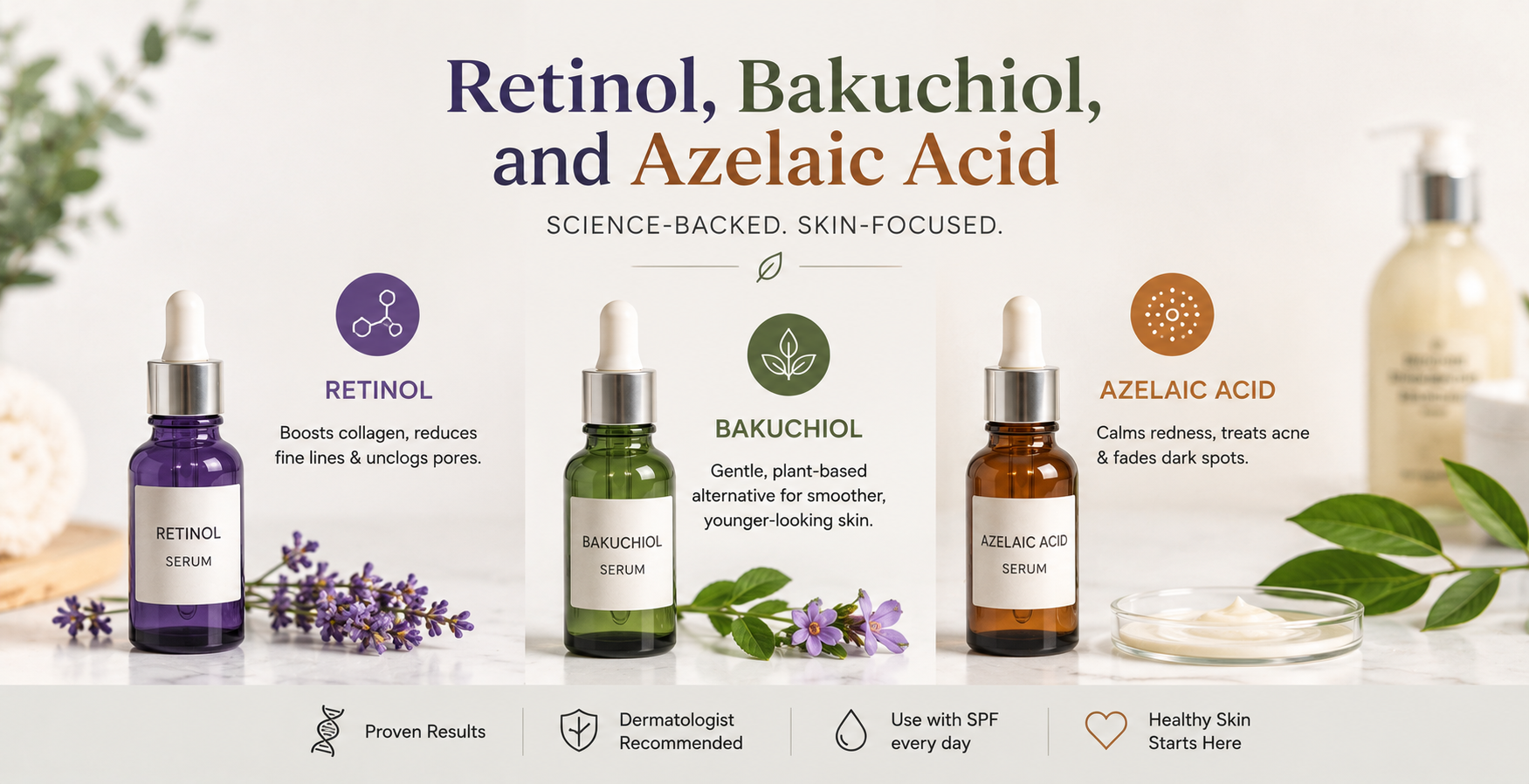
Modern skincare has become increasingly focused on ingredients backed by scientific research rather than marketing claims. Among the most talked-about ingredients are retinol, bakuchiol, and azelaic acid. Each has gained popularity for improving common skin concerns such as acne, uneven skin tone, fine lines, and redness, but they work in very different ways.
Although these ingredients are often compared with one another, they are not direct substitutes. Each offers unique benefits, has different safety considerations, and may be more suitable for certain skin types or conditions. Choosing the right ingredient depends on your individual skincare goals, skin sensitivity, and overall routine.
This guide explains how retinol, bakuchiol, and azelaic acid work, their proven benefits, potential side effects, and how to decide which option may be best for your skin.
Understanding Active Skincare Ingredients
Active ingredients are compounds that produce specific biological effects within the skin. Unlike moisturizers that mainly hydrate the skin’s surface, active ingredients influence processes such as cell turnover, collagen production, inflammation, pigmentation, and oil production.
Because these ingredients affect skin biology, introducing them gradually and using them correctly is essential for maximizing benefits while minimizing irritation.
What Is Retinol?
Retinol is a vitamin A derivative belonging to the retinoid family. It is one of the most extensively researched anti-aging ingredients in dermatology.
After being absorbed into the skin, retinol is converted into retinoic acid, the active form that influences skin cell behavior. It accelerates skin cell turnover, stimulates collagen production, improves skin texture, and helps unclog pores.
For these reasons, retinol is commonly recommended for treating fine lines, wrinkles, sun damage, acne, enlarged pores, and uneven pigmentation.
Visible improvements usually develop gradually over several weeks to several months of consistent use.
Benefits of Retinol
Retinol has strong scientific evidence supporting multiple skin benefits.
Regular use can soften fine lines, improve skin elasticity, reduce rough texture, fade post-inflammatory pigmentation, minimize acne breakouts, and create a smoother, more even complexion.
Because collagen production naturally declines with age, retinol remains one of the most effective non-prescription ingredients for maintaining youthful-looking skin.
Possible Side Effects of Retinol
Despite its effectiveness, retinol is also known for causing irritation, particularly during the first few weeks of treatment.
Dryness, redness, peeling, flaking, burning sensations, and increased sun sensitivity are relatively common while the skin adjusts.
Most dermatologists recommend starting with a low concentration two or three nights per week before gradually increasing frequency.
Daily sunscreen is essential because retinol makes the skin more sensitive to ultraviolet radiation.
Pregnant or breastfeeding individuals should consult their healthcare provider before using retinoids, as certain vitamin A derivatives are not recommended during pregnancy.
What Is Bakuchiol?
Bakuchiol is a plant-derived compound extracted from the seeds and leaves of the Psoralea corylifolia plant.
It has become increasingly popular as a gentler alternative to retinol because laboratory studies suggest it activates some of the same cellular pathways involved in collagen production and skin renewal.
Unlike retinol, bakuchiol is not a vitamin A derivative.
Benefits of Bakuchiol
Several clinical studies suggest that bakuchiol may improve fine lines, skin firmness, elasticity, pigmentation, and overall skin texture.
Its anti-inflammatory and antioxidant properties may also help calm irritated skin while protecting against environmental damage.
Many individuals with sensitive skin tolerate bakuchiol better than retinol because it is less likely to cause peeling, dryness, or irritation.
Bakuchiol can often be used both morning and evening because it does not significantly increase photosensitivity. Nevertheless, sunscreen remains an essential part of every skincare routine.
Limitations of Bakuchiol
Although early research is promising, bakuchiol has not been studied nearly as extensively as retinol.
Current evidence suggests it may provide similar cosmetic improvements for some people, but the quantity of long-term scientific data remains considerably smaller.
Individuals seeking the strongest evidence for wrinkle reduction and acne treatment may still benefit more from retinoids under appropriate guidance.
What Is Azelaic Acid?
Azelaic acid is a naturally occurring dicarboxylic acid produced by certain grains, including wheat, barley, and rye.
It has been used in dermatology for decades because of its anti-inflammatory, antibacterial, and pigment-reducing properties.
Unlike retinol, azelaic acid primarily works by reducing inflammation, normalizing skin cell growth, decreasing acne-causing bacteria, and slowing excess melanin production.
Benefits of Azelaic Acid
Azelaic acid is particularly valuable for treating acne, rosacea, post-inflammatory hyperpigmentation, and melasma.
Its anti-inflammatory effects help reduce redness and facial flushing associated with rosacea while also decreasing inflammatory acne lesions.
By inhibiting excess pigment production, azelaic acid gradually fades dark marks left behind after acne and improves uneven skin tone.
Many dermatologists consider it one of the safest active ingredients for individuals with sensitive or rosacea-prone skin.
Possible Side Effects of Azelaic Acid
Most people tolerate azelaic acid well.
Some individuals experience mild tingling, temporary burning, dryness, or itching during the first few weeks of treatment.
These effects often improve as the skin adapts.
Compared with retinol, azelaic acid generally causes significantly less irritation.
Which Ingredient Is Best?
The answer depends entirely on your skincare goals.
Retinol remains the gold standard for improving signs of aging, stimulating collagen production, and treating acne in many individuals.
Bakuchiol may be an excellent option for people with sensitive skin who cannot tolerate retinol but still want to improve skin texture and early signs of aging.
Azelaic acid is often the preferred choice for rosacea, inflammatory acne, facial redness, melasma, and post-inflammatory pigmentation.
In many dermatology treatment plans, these ingredients are not viewed as competitors but rather complementary therapies used for different purposes.
Can They Be Used Together?
In many cases, yes.
Azelaic acid is frequently combined with retinol because it may help address pigmentation and inflammation while retinol targets collagen production and cell turnover.
Bakuchiol has also been formulated alongside retinol in some products to help reduce irritation while maintaining anti-aging benefits.
However, combining multiple active ingredients should be done gradually to avoid excessive irritation, especially in sensitive skin.
When introducing more than one active ingredient, it is generally advisable to add only one new product at a time and monitor the skin’s response.
Daily Sun Protection Is Essential
Regardless of which ingredient is chosen, sunscreen remains the most important anti-aging skincare product.
Ultraviolet radiation contributes to premature aging, pigmentation, collagen breakdown, and skin cancer.
Using a broad-spectrum sunscreen with SPF 30 or higher every day helps protect treatment results while reducing future skin damage.
Without consistent sun protection, many skincare treatments become less effective.
Frequently Asked Questions
Is bakuchiol as effective as retinol?
Early studies suggest bakuchiol may provide similar improvements in skin texture and fine lines for some individuals with fewer side effects. However, retinol currently has much stronger long-term scientific evidence.
Can azelaic acid treat acne?
Yes. Azelaic acid is an established treatment for mild to moderate acne and also helps reduce post-acne pigmentation.
Which ingredient is best for sensitive skin?
Bakuchiol and azelaic acid are generally better tolerated than retinol, although individual responses vary.
Can I use retinol every night?
Not initially. Most people benefit from introducing retinol gradually to reduce irritation before increasing frequency as tolerated.
Do I still need sunscreen if I use these ingredients?
Yes. Daily sunscreen is recommended regardless of which active ingredient you use and is particularly important when using retinol.
The Bottom Line
Retinol, bakuchiol, and azelaic acid each offer scientifically supported skincare benefits, but they serve different purposes. Retinol remains the most extensively studied ingredient for reducing wrinkles, improving skin texture, and stimulating collagen production. Bakuchiol provides a gentler plant-based alternative for individuals with sensitive skin, while azelaic acid excels in treating acne, rosacea, redness, and hyperpigmentation.
Rather than asking which ingredient is universally “best,” it is more helpful to identify your primary skin concerns and choose products accordingly. With consistent use, appropriate sun protection, and realistic expectations, all three ingredients can play an important role in achieving healthier, more balanced skin.
